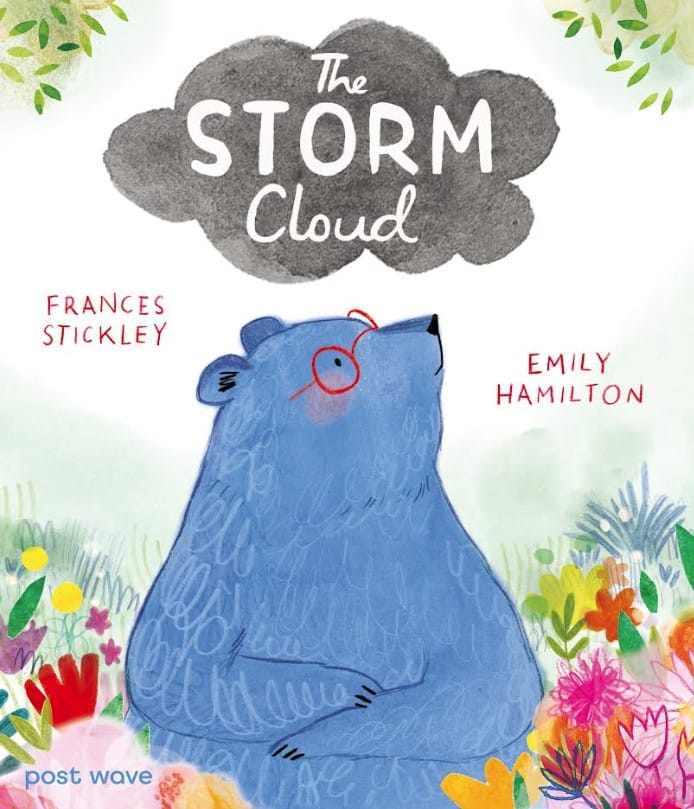
Today we welcome Frances Stickley into The Reading Realm to talk about her brand-new book THE STORM CLOUD, which is illustrated by Emily Hamilton. Frances Stickley is a bestselling children’s author, primary school teacher and literacy specialist with a background in teaching children permanently excluded from mainstream education.

Welcome! Before we settle down in The Reading Realm to talk about THE STORM CLOUD, what’s your drink and snack of choice?
I’m going to ask for a Rowntree’s Secret bar since you can’t get them anymore and I’m treating this as your contractual obligation to petition them.
Also, a hot egg and a crescent of crisps. And mead. Thank you.
What can you tell us about your new book?
The Storm Cloud is a gentle story about sitting with sadness and the power of friendship to weather even the heaviest of storms. Bear is shocked to wake one day with a storm cloud hanging right above his head and, try as he might, he just can’t make it go away. But luckily for Bear, he does have some very special friends in his corner.
It’s not wildly demonstrative or revolutionary, but that’s kind of the point. When people feel heavy feelings, there can be a knee-jerk reaction from both them and their loved ones to do something big and interventionist to make things better fast because it doesn’t feel safe to sit with those feelings. But these things rarely work that way. The Storm Cloud is about the powerfulness of quiet companionship without judgement, the act of listening over speaking and the act of patience over proactiveness.
What inspired this story?
I wrote the first draft of the book way back in lockdown, when it started to become very clear that – to state the obvious – kids were going to struggle a bit with ‘all this’ (waves hand in overwhelm). And what actually happened was a massive mental health crisis among young people that we’re still in chaotic cahoots with now. I didn’t come back to it for a while because I wanted to get it right.
I wanted a way to address the inevitable onset of sadness without delving too much into looking for reasons. Sometimes that’s really healthy, but in a worldwide pandemic, transitional shifts and amplification of feeling are almost guaranteed and the idea of weathering the storm seemed a fitting device for a sadness that was generally collective and ubiquitous.
Do you have a favourite illustration from the book?
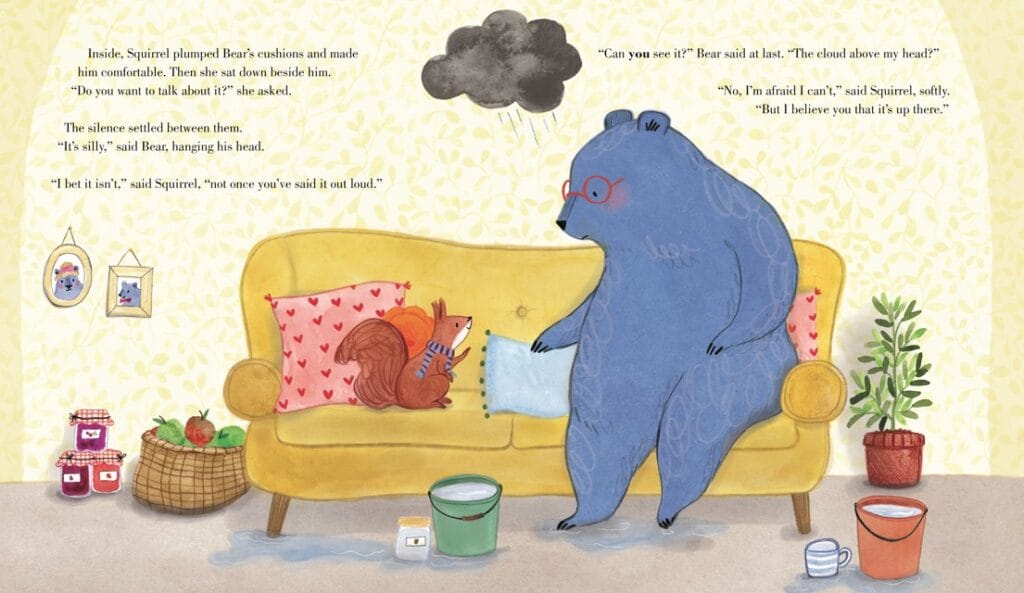
This is the moment in the book where Squirrel admits that he can’t see the storm cloud, but he believes Bear that it’s up there, and you can almost see the relief in Bear’s little face. Big, difficult feelings are so often a weird alchemy of events all interwoven with our own hang-ups that they feel – and are – enormously personal, and subsequently, it can feel like a totally isolating experience that no one else could possibly understand. So I love this bit, because Squirrel is validating that without assuming to know the fabric of what Bear is feeling. Also, this sofa is so good. I would buy this sofa.
What are your own childhood memories of books and reading?
I didn’t much exist outside of my own interiority for the first twelve years of my life so anything that I read went straight into the old mind palace. I don’t think I read more than anyone in particular, but my brain holds onto words . It’s why I can remember every single word to 90s reggae. Do you want to hear my Chakademus and Pliers?
My favourite books though were Enid Blyton – which is pretty standard for our generation – and I was also lucky enough to read a lot of the Moomin books when we were little. We had access to our parents’ bookshelf too so I do remember reading the Monty Python book cover to cover at the age of about 7. Also Flowers in the Attic, which I do not recommend. There are no flowers and the attic is really a red herring.
Finally can you describe THE STORM CLOUD in three words?
Meditative, permissive, hopeful
I am now an affiliate for Bookshop.org! If you buy books through my custom lists or links, I earn a 10% commission, and another 10% goes to support local indie bookstores.